

Technology
Proof,precisely Stated.
Every figure on this page is shown at the scale it was measured. That precision is deliberate: it lets you judge the numbers the way an engineer would.
- The first spark — legend, not settled fact In Parthian-era Iraq, a clay jar holding a copper cylinder and an iron rod. Fill it with an acidic liquid and it can produce a faint charge. Since its discovery near Baghdad in 1936 it has been called the “Baghdad Battery”. Most archaeologists doubt it was ever used as one — a storage vessel or ritual object is likelier. We keep it as an open mystery.
- Naming it, then building it Benjamin Franklin borrows the military word “battery” for linked Leyden jars — many firing together. In 1780 Luigi Galvani sees a frog’s leg twitch between two metals and calls it animal electricity. In 1800 Alessandro Volta shows the metals, not the frog, make the current: zinc and copper discs separated by brine-soaked card. The first battery that could deliver a steady current.
- Zinc’s promise Volta’s own pile used zinc. It is abundant, inexpensive, non-toxic and does not burn, and disposable zinc batteries went on to power the twentieth century. The one thing zinc never learned to do well was recharge.
- Why the world defaulted to lithium The century needed rechargeable storage, and zinc kept failing at it. Lithium-ion filled the gap: energy-dense, and it worked. The trade-off the world accepted was a chemistry that can catch fire, a supply chain concentrated in one country, and a whole industry of armor, cooling, suppression and set-back distances built to manage the risk.
- The problem nobody solved Engineers kept trying to make zinc rechargeable and kept meeting the same three failures at once — and fixing one made another worse. Dendrites: spiky deposits that short the cell. Gassing: the electrolyte breaks down and the cell pressurises and dries. Shape change: the zinc migrates away from where it is needed. Nobody suppressed all three together.
- The breakthrough QED’s electrode architecture controls all three limiting mechanisms simultaneously — the simultaneity is the invention. The electrolyte is water-based, so the cell cannot enter thermal runaway. No lithium. No cobalt. Measured so far in QED’s research program with Ontario Tech University, with the scope of each result:
- ~241 mAh/g initial specific capacity A small, button-shaped test cell used to measure a chemistry at laboratory scale.
- ~78% capacity retention at 1,000+ full cycles A flat, rectangular cell format used in storage systems — closer to a finished product than a laboratory coin cell.
- ~2,500+ cycles at 0–100% depth of discharge A small, button-shaped test cell used to measure a chemistry at laboratory scale.
- 50,000+ electrode cycles A test of one electrode on its own. It shows how that electrode ages; it is not a system lifetime.
- 210+ Wh/kg specific energy A small, button-shaped test cell used to measure a chemistry at laboratory scale.
- under ~3 min to reach 90% charge Measured on an individual cell, not on a complete battery system.
- Zero observed gas evolution A small, button-shaped test cell used to measure a chemistry at laboratory scale.
- Remove the failure mode, not the symptoms When the chemistry cannot burn, the costs that grew up around fire risk fall away: shipping, insurance, permitting, siting and handling. That is the business case behind the safety — and it is why the buyers who can least afford the old trade-off, from data centers to hospitals, care most.
- The invitation A fifty-year problem has been solved, and the proof is measured, qualified and growing.
- Dendrites Spiky zinc deposits grow on charging until they bridge the gap and short the cell.
- Electrolyte breakdown and gassing The water-based electrolyte decomposes and gives off gas. The cell pressurises and dries out.
- Active-material redistribution Zinc migrates away from where it is needed, hollowing out capacity cycle by cycle.
The proof
What has been measured
Here is what has been proven, precisely, at the scale it was tested. Larger formats appear here as they are validated — and not before.
| Measure | Result | Scope |
|---|---|---|
| Initial specific capacity | ~241 mAh/g | A small, button-shaped test cell used to measure a chemistry at laboratory scale. |
| Capacity retention at 1,000+ full cycles | ~78% | A flat, rectangular cell format used in storage systems — closer to a finished product than a laboratory coin cell. |
| Cycles at 0–100% depth of discharge | ~2,500+ | A small, button-shaped test cell used to measure a chemistry at laboratory scale. |
| Electrode cycles | 50,000+ | A test of one electrode on its own. It shows how that electrode ages; it is not a system lifetime. |
| Specific energy | 210+ Wh/kg | A small, button-shaped test cell used to measure a chemistry at laboratory scale. |
| To reach 90% charge | under ~3 min | Measured on an individual cell, not on a complete battery system. |
| Observed gas evolution | Zero | A small, button-shaped test cell used to measure a chemistry at laboratory scale. |
- Coin cellMeasured
- Prismatic cellIn validation
- Full systemsIn development
Every figure is shown at the scale it was measured. A coin-cell or single-electrode result describes that test — it is not a system lifetime.
- QED
- LFP
- NMC
- Sodium-ion
- Lead-acid
Research and review
Developed in our lab, reviewed by government scientists
QED’s research program runs with Ontario Tech University, its research partner. Since 2020 the work has been reviewed eight times by Canadian government scientists, and it has been supported by the National Research Council of Canada’s Industrial Research Assistance Program (NRC-IRAP), NSERC, Mitacs and the Ontario Centre of Innovation (OCI).
QED’s cells use a water-based (alkaline) electrolyte, with engineered structures at both electrodes that prevent the historical failure modes. How those structures work is protected. What they do is measured, and shown above at the scale of each measurement.
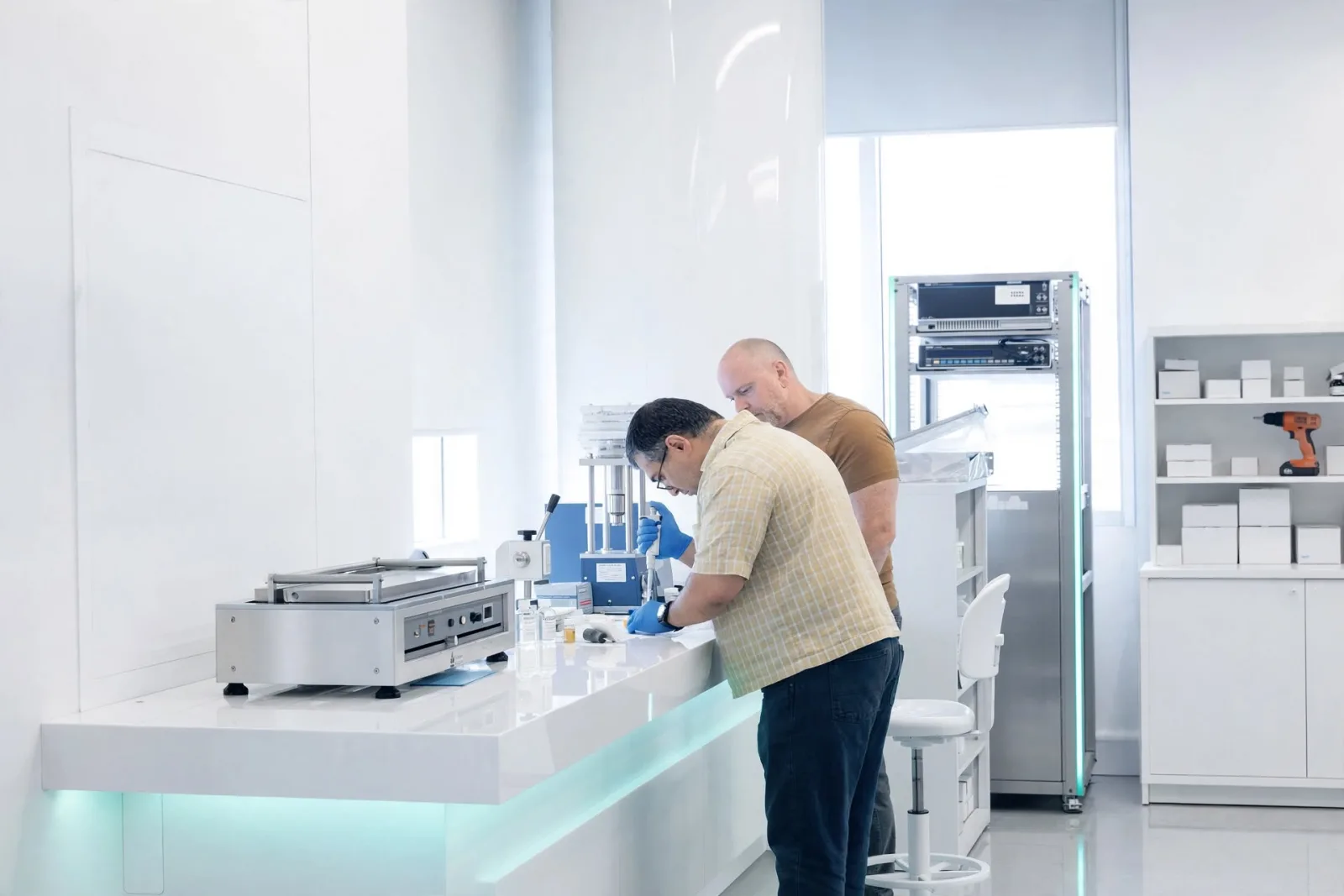
The QED team in the lab · photograph, image edited
- Rechargeable alkaline zinc A zinc battery that can be charged and discharged again and again, instead of being used once.
- Thermal runaway A self-accelerating overheating in which heat causes more heat — the failure behind battery fires.
- Non-combustible Will not burn. A property of the chemistry itself, not of fire-suppression equipment added around it.
- Electrolyte The liquid or gel that lets ions move between the electrodes. In QED cells it is water-based (alkaline).
- Dendrite A spiky, tree-like metal deposit that can grow on an electrode during charging and bridge to the other electrode, shorting the cell.
- Gassing An electrolyte breaking down and giving off gas, which pressurises and dries out a cell.
- Shape change Active material slowly migrating across an electrode over many cycles, losing capacity as it goes.
- Cycle One full charge followed by one full discharge. Cycle life counts how many a cell survives before it degrades.
- Depth of discharge (DoD) How much of a battery’s capacity has been used. Draining it halfway is a 50% depth of discharge.
- Half-cell A test of one electrode on its own. It shows how that electrode ages; it is not a system lifetime.
- Coin cell A small, button-shaped test cell used to measure a chemistry at laboratory scale.
- Specific capacity (mAh/g) How much charge a material stores per gram of active material.
- Specific energy (Wh/kg) How much energy a cell stores per kilogram of cell.
- Solid-state battery A battery with a solid rather than liquid electrolyte, sought after for high energy density.
- Energy density (Wh/L) How much energy a cell stores per liter of volume.
- C-rate How fast a battery is charged or discharged relative to its capacity. 1C means a full charge or discharge in one hour.
- Prismatic cell A flat, rectangular cell format built from stacked layers, widely used in storage systems.
- Recyclable Materials can be recovered and reused at end of life instead of being discarded.
- Capacity retention The share of a cell’s original capacity it still holds after a number of cycles.
- State of charge (SoC) How full a battery is right now, shown as a percentage — like 45% on a phone.
- State of health (SoH) A battery’s overall condition compared with when it was new. Lose a fifth of the capacity permanently and SoH is 80%.
- Internal resistance The opposition to current inside a cell. Lower resistance means less energy wasted as heat.
Absolute Safety, Absolute Energy.
Next
Questions about the science?
Ask QED at the bottom right, or write to the team. If a number is not on this page, it has not been validated yet.